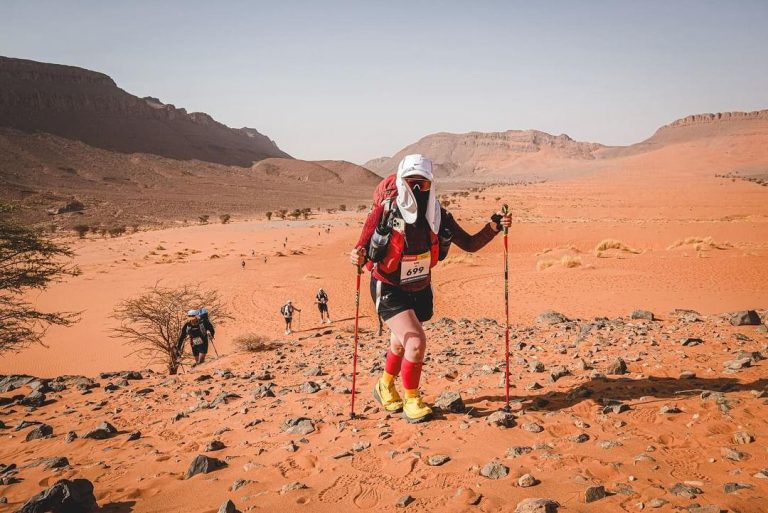
If you spend enough time looking after runners’ feet in desert ultras, you realise quite quickly that blister prevention is rarely about one miracle product. It is usually about a system: the right shoe, enough room for swelling, the perfect sock combination, increased training load , skin conditioning, and knowing when to act early on a hotspot. Within that system, Armaskin liner socks can be a very helpful tool for some runners, but not always for everybody.
This blog is an honest look at where Armaskin liner socks fit into desert ultra running, based on the internal Blisterhelp Marathon des Sables pilot study and the advice already shared on Blisterhelp about friction, moisture, swelling and hot-weather foot care. The short version is this: they can work brilliantly in the right set-up, but they need testing early, sizing carefully and wearing as part of a wider blister prevention strategy rather than as a last-minute fix.
About me

I am an expedition podiatrist specialising blister prevention and treatment. I have served on medical teams at the Marathon des Sables (MDS legendary) Fire and Ice Ultra in Iceland, Sheultra™, London Marathon and the Great North run. I’m used to diagnosing complex cases of overuse injuries and treating infections, sprains, pressure sores, chafing and a wide range of blister problems, commonly seen at these events.
After I return home, I then reflect on the issues I have seen and treated, and write about the problems that could have been prevented for the next cohort of runners
Why do desert ultra marathons wreck your feet?
A desert ultra is not just a long run in the heat. The repeated impact, sand, camber, pack weight, footwear and the sheer number of hours on your feet all combine to make blister risk much higher than in an ordinary road marathon. On top of that, the feet often swell as the days go on.
Once fluid starts building in the feet, the shoe volume effectively shrinks. The edges of the foot press against the shoe, toes are pushed together, laces cut across the top of the foot, and pressure points develop very quickly. That is often the moment when a mild hotspot turns into a full-blown fluid blister.
This is one of the reasons I talk so much about foot swelling (oedema) in desert races. It is one of the most underestimated causes of blister problems in stage racing. Runners often focus on “rubbing” alone, but the real issue is frequently a combination of swelling, pressure, moisture, bone movement, lack of conditioning all working together.
How do Armaskin liner socks work?
Armaskin liner socks are designed to be worn underneath your usual moisture wicking (technical) outer sock, creating a double-sock system. The inner surface of the Armaskin sock grips the skin lightly, while the outer surface is smooth, so the movement is encouraged to happen between the sock layers rather than directly on the skin. That means the sock takes the shear forces instead of your skin.
They are also designed to transport moisture away from the skin into the outer sock. In desert conditions, where heat and sweat are relentless, this matters as wet skin blisters more easily. By wicking moisture into the outer sock and keeping the skin surface drier, you reduce one more part of the blister problem.
Friction, moisture and shear
Blisters are caused by repeated shear stress in the skin. Think of the soft tissues underneath being tugged backwards and forwards while the top layer tries to stay put. Armaskin tries to interrupt this by creating a low-friction “slip plane” between the inner and outer sock, so that relative movement happens in the sock system rather than in the skin layers.
If you add an increased moisture wicking outer sock on top of the Armaskin liner , you have a set-up that tackles friction, shear and sweat all at once, which are three of the big contributors to blisters in hot, sandy environments.

Swelling and compression in stage races
What makes Armaskin particularly interesting in desert racing is that they may help with more than just friction. Because they fit closely to the skin, with added compression, runners feel they help reduce fluid build-up in the feet during long, hot stages. The compression-like fit can support the soft tissues and limit the amount of fluid/volume in the feet as the hours tick by.
That matters because once the foot swells and starts pushing harder into the shoe upper, the edges of the foot, the insole and the toe box, the skin is much more vulnerable to hotspot formation and blistering. One of the underrated benefits of Armaskin liner socks in a desert ultra is not just friction reduction, but their ability to help limit the fluid build-up that makes feet swell, shoes tighten and blisters escalate as the race goes on.

What did the MDS pilot study show about Armaskin?
In the 2025 Blisterhelp internal Marathon des Sables pilot study, Armaskin liner socks were included in the blister-prevention kit and used by all 29 race participants. They sat alongside other prevention measures such as moisture-wicking outer socks, Engo patches, Poron insoles, Alpaca wool and Dermatonic cream, so they were part of a wider prevention system rather than a stand-alone intervention.
The study showed that Armaskin use in the desert was often more positive than runners’ first impressions in training. Several runners described them as strange, very tight or awkward at first, but then reported clear benefits once they had found the right size and had adapted to the feel.
Positive feedback from runners
One runner wrote:
“Using them I had no hot spots, not using them created hot spots.”
Another said:
“Definitely game changer! I will always use them in future!”
There were also runners who said they would definitely wear them again and tent-mates who were surprised by how well they worked when everyone else was getting blisters.
Did Armaskin socks really reduce foot swelling and fluid build-up?
The swelling point came through strongly in the feedback. Many participants indicated that the Armaskin liners helped reduce swelling in their feet in the desert. That is important, because swelling often changes shoe fit more than runners expect by day three or four.
One runner said:
“First use the compression was painful, but feet got use to them and I’m sure the compression helped in desert.”
Another participant described changing size strategy because of foot inflammation, using a larger size later in the race to accommodate how the feet changed under desert conditions.
There were also comments that captured just how different the socks could feel in the desert compared with training at home. One runner said:
“In the desert though the experience with the Armaskins was totally different and my feet held up in great shape so I continued to use them and was amazed as everyone around me got blisters and I was fine… In the desert heat, the wicking worked perfectly and my feet were bone dry at the end of each day.”
That sort of experience is exactly what you want to see and hear in a desert race: drier skin, fewer hotspots, less swelling and the ability to keep moving while others are queuing for the medical tent.
Who should consider Armaskin for a desert ultra?
From the study and from clinic work, there are clear groups of runners who are more likely to benefit:
- Runners with a history of friction blisters on the heels, the edges of the feet, arches or balls of the feet, despite accommodating shoes and decent socks.
- Runners whose feet swell a lot in long, hot races, and who have previously felt their shoes “shrink” as the days go on.
- Multi-day desert runners who will be on their feet for long stages and need every bit of help they can get with friction, moisture and swelling.
- Runners willing to test properly, starting months in advance, experimenting with sizing, and doing long sessions in heat or sand before race week.
If that sounds like you, Armaskin is worth serious consideration as part of your prevention system.
What are the downsides of Armaskin liner socks?
This is the bit that deserves to be just as clear. Armaskin liner socks are not universally loved.
Common issues reported in the pilot study included:
- Feeling very tight or compressive, especially in smaller sizes.
- An adaptation period where feet felt hot, compressed or “weird” on early runs.
- Toe seam rubbing for some foot shapes, leading to toe-tip irritation or blisters.
- Pressure across the top of the foot if the shoe was already on the snug side.
Some of the comments illustrate this:
- “My feet hurt for the first 2–3 weeks.”
- “Found my feet overheating the first run.”
- “They gave me blisters on the tips of my toes rubbing the seam.”
- “Very tight and put pressure on the upper part of my foot.”
These are not minor details. If the fit is wrong, the very features that help one runner can make things worse for another.
It is also important to point out that Armaskin will not fix problems that are fundamentally about shoe choice, toe box depth, gait or pack weight. If your main issue is toes hitting the front of the shoe, toenail problems, or forefoot overload from your running style and pack, then liner socks alone are not going to solve that.
How should I test Armaskin before a desert race?
If you decide to try Armaskin, treat them like any other critical bit of race kit.
Step 1: Short runs at home
Start with easy runs or walks of 5–10 km in the shoes and outer socks you plan to use. Expect them to feel snug. Check for any pinching, numbness, or rubbing over the toes or instep. If they feel too tight straight away, consider going up a size sooner rather than later.
Step 2: Long, hot, pack-laden sessions
Once they feel acceptable on short runs, move towards race-like sessions:
- Longer runs back-to-back.
- Heat training in a warm room, on a treadmill, or abroad if possible.
- Sand, uneven terrain and pack weight.
By the time you are confident in them, you should have done at least a couple of long, loaded, hot days in something close to race conditions.
Step 3: Lock your race-day sock system early
A desert ultra is not the place to be experimenting with socks. Once you find a combination that works, whether that includes Armaskin or not, lock it in and stick with it. The runners who arrived at this MDS with a well-tested system and resisted the temptation to change last minute generally had better feet than those still experimenting in the Sahara.
Are Armaskin liner socks worth it for my desert ultra?
My honest view is that Armaskin liner socks can be extremely effective in desert ultras for the right runner, especially where friction and foot swelling are both part of the problem. I have seen them help runners keep their feet drier, reduce hotspots and feel more protected through long hot stages. I have also seen runners struggle with them because they were too small, too compressive, poorly matched to the shoe, or simply not right for that person’s foot shape.
So, I would not label them “essential” for everyone. I would describe them as a serious option for the majority that deserves proper testing, especially if:
- You are prone to friction blisters under load.
- Your feet swell noticeably in long hot races.
- You want your sock system to tackle friction, moisture and swelling together rather than one at a time.
If they work for you, they can be excellent. If they do not, it is far better to find that out in training than on day two of Marathon des Sables.
FAQ about Armaskin liner socks for desert ultras
Can Armaskin liner socks reduce foot swelling in Marathon des Sables?
Yes, they do limit fluid build-up in the feet, which can reduce pressure, toe crowding and friction as the race goes on. That was one of the more interesting outcomes from the Blisterhelp internal pilot study.
Do Armaskin socks stop blisters completely?
No. They can reduce some of the major causes of blisters, especially friction, moisture and foot swelling, but they are not a guarantee. Shoe fit, lacing, back-pack weight, gait, skin conditioning and race management still matter.
Are Armaskin liner socks too hot for desert racing?
Some runners do find them odd at first, especially in training, but others report the opposite in the desert once they are paired with the correct outer sock. Several runners found that their feet actually felt drier in the race.
How long do the Armaskin socks last for?
Usually in normal conditions approximately 265 miles, but in the desert conditions that could be less milage. I always advise taking two pairs into an event, not because of the distance but the unpredictable can happen in the desert, and that is the one bit of your kit you need a backup of.


How long before a desert ultra should I start testing Armaskin?
Ideally you should start months before the race, not weeks. That gives you enough time to test sizing, adapt to the feel, and do long sessions in conditions that are as close to race day as possible. Using 2-3 pairs in training is advised as they are not designed to last more than 265 miles
Should I wear Armaskin with a merino outer sock?
For many runners, yes. A moisture-wicking outer sock, often merino-based, works well over the Armaskin liner. The exact combination still needs personal testing because foot shape, shoe fit and sweat patterns vary.
What if Armaskin feels too tight in training?
Do not ignore it, recheck the size, check how you are putting them on, and assess whether your shoe has enough room for the liner and outer sock together. In many cases, sizing up or changing the fit strategy makes a big difference.
I have found that sizing up if you have a wider foot, or at the upper cusp of a size, is to be recommended. If Armaskin eventually brings in width fitting, then this advice will change. ( I seriously hope they do!)
I get toe blisters, will Armaskin liner socks make them worse?
The compression of the sock can increase the pressure on the toe area, but I recommend that alpaca wool is used to separate the toes daily as a prevention and this works well in practice. Alternatively, a cut can be made in the Armaskin toe area to reduce the tension of the sock on the toes.


Overall, Armaskin liner socks are worth considering in the prevention of blisters in the desert ultra, sizing correctly and training in them is essential to a successful outcome
Blisterhelp Marathon Des Sables Pilot Studies
Featured Products


About The Author
I’m Lindsey Ebbs, a podiatrist with more than three decades of clinical experience and a passion for working in the world’s toughest endurance events.